The Unfulfilled Dream of Titanfall 3: A CEO's Hope vs. Corporate Reality
Titanfall 3 CEO hopes and Titanfall franchise drama ignite fan longing, overshadowed by Apex Legends' dominance and Respawn's Star Wars focus.
In the year 2026, the ghost of a legendary mecha-shooter continues to haunt the halls of Respawn Entertainment. The CEO, Vince Zampella, stands as a lone voice in the corporate wilderness, repeatedly whispering a forbidden desire into the ears of investors and fans alike: the dream of Titanfall 3. Yet, what good is a dream when it is perpetually deferred? For over a decade, the Titanfall franchise has been the brilliant, neglected older sibling, forever living in the colossal, money-printing shadow of its offspring, Apex Legends. The CEO’s personal yearning for a third installment is a poignant drama played out in public, a tantalizing ‘what if’ that contrasts sharply with the cold, hard reality of Respawn’s current portfolio—dominated by Apex Legends and a galaxy far, far away with Star Wars. Is this the tragic fate of a groundbreaking series: to be remembered fondly but never revived?
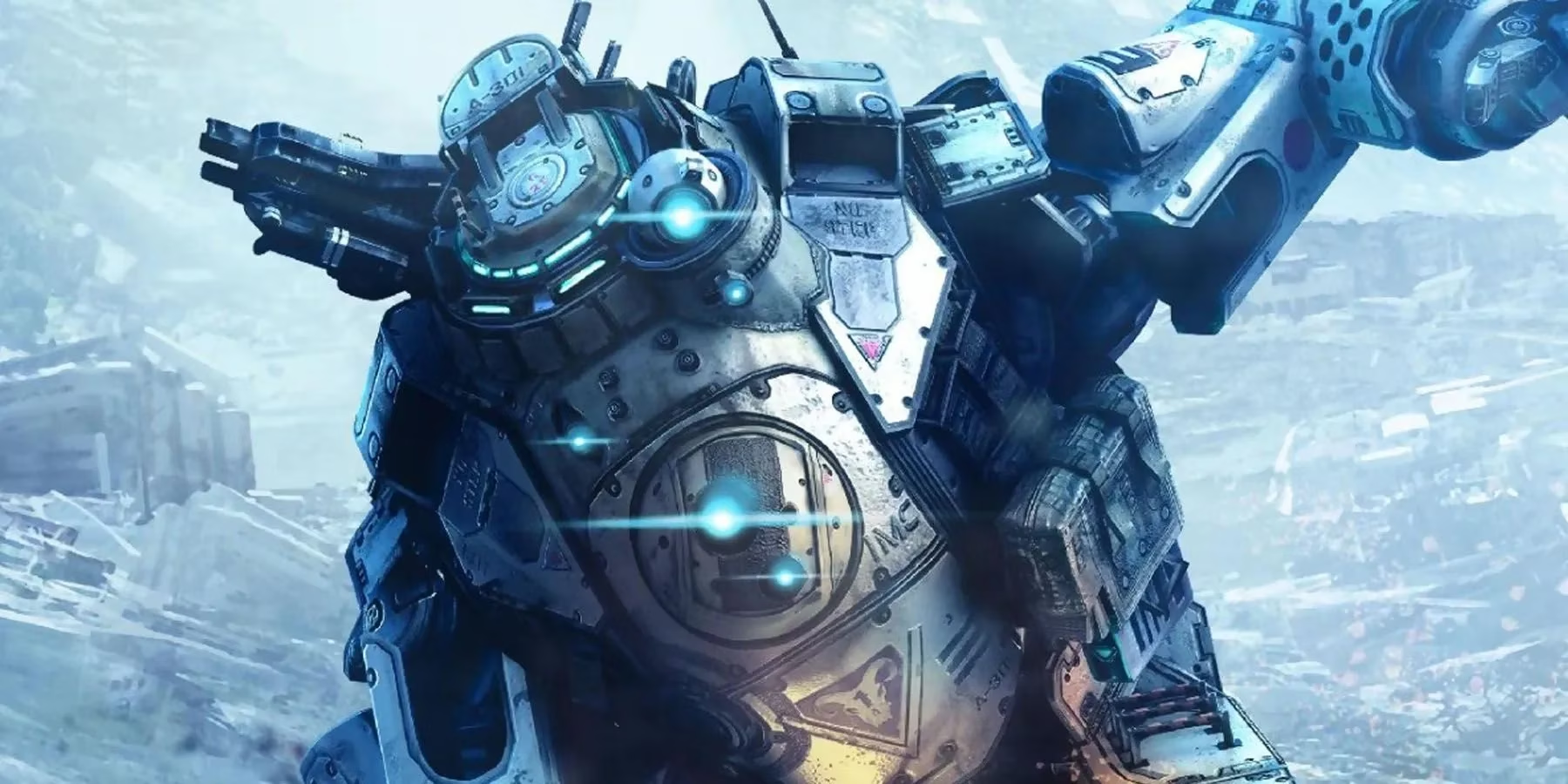
The Phoenix That Refuses to Rise: A History of Misfortune
The saga of Titanfall is one of phenomenal potential tragically hampered by circumstance. Let's rewind the clock. Titanfall (2014) burst onto the scene like a meteor, introducing a revolutionary blend of frenetic pilot parkour and devastating mech combat. It was a proof of concept, a dazzling first draft. Then came Titanfall 2 (2016), a masterpiece that left critics and players awestruck. Its campaign, though concise, was a masterclass in level design and emotional storytelling—who could forget the bond with BT? Its multiplayer refined the formula to near-perfection.
But here lies the great irony, the catastrophic misstep that arguably doomed the franchise's momentum. The game was released in perhaps the worst possible window in gaming history, brutally sandwiched between two juggernauts:
| Release Date (2016) | Game Title | Franchise Power |
|---|---|---|
| October 21 | Battlefield 1 | Colossal |
| October 28 | TITANFALL 2 | (The Victim) |
| November 4 | Call of Duty: Infinite Warfare | Behemoth |
How could any game, no matter how brilliant, survive that meat grinder? The sales, while respectable, were not the blockbuster numbers Electronic Arts (EA) craves. This commercial ‘disappointment’ became the foundational trauma, the reason Respawn’s corporate overlords have been so hesitant to greenlight a sequel. Why risk resources on a ‘proven’ moderate success when you have a veritable gold mine in Apex Legends?
The Apex Leviathan and the Star Wars Galaxy
Ah, Apex Legends. The battle royale that emerged from Titanfall's ashes and consumed its legacy. By 2026, Apex isn't just a game; it's a cultural institution, a live-service titan that demands constant feeding with seasons, characters, and events. It is Respawn's undisputed priority, the engine that funds everything else. And let's not forget the other elephant in the room—or rather, the Star Destroyer. Respawn has become a key studio for EA's Star Wars ambitions. With the acclaimed Jedi: Survivor series and other projects, the studio's creative bandwidth is stretched across a beloved universe with a built-in audience of billions. Where, pray tell, does Titanfall fit into this equation?
CEO Vince Zampella’s statements are a study in corporate doublespeak layered with genuine passion. He has publicly stated the studio has "no dedicated plans" for Titanfall 3. Yet, in the same breath, he confesses he "would love to see it happen." He sets near-impossible conditions for its return: it must be the "right idea" at the "right time," and it must not alienate the millions of Apex Legends fans who have never set foot in a Titan. Is this a sincere assessment of the challenges, or a convenient list of excuses?
The Shared Universe Conundrum: A Blessing and a Curse
The Titanfall/Apex Legends shared universe is both the franchise's greatest asset and its biggest narrative prison. On one hand, it provides a rich lore filled with iconic characters (Blisk, anyone?), factions, and technology. On the other, it creates a paradoxical problem. How do you make a true, full-blooded Titanfall 3 that satisfies the core fans' desire for a focused mech-infused military shooter without confusing the Apex player who knows this world only through legends, guns, and ring closures?
Consider the leaked and reportedly canceled single-player Apex Legends project. Was that the compromise? A narrative-focused game set in the universe but without the Titans, designed as a gateway drug? Its cancellation suggests even that middle ground was deemed too risky. The path forward is murky. Should Titanfall 3 be:
-
A direct sequel to Titanfall 2's story, ignoring Apex? (Risky!)
-
A prequel focusing on an antagonist, like Kuben Blisk? (Interesting!)
-
A hybrid that slowly introduces Titans to the Apex gameplay loop? (Potentially disastrous!)
The Fandom's Eternal Vigil
Despite the silence from the developers, the fan base for Titanfall has never truly died. It is a passionate, vocal community that keeps the servers alive, creates stunning fan art, and dissects every morsel of lore hidden in Apex Legends. They are the living testament to the series' enduring quality. Every time Zampella mentions Titanfall, the community erupts—not with entitlement, but with renewed, desperate hope. They remember the feel of calling in a Titan, the crunch of metal, the fluidity of movement that no other game has perfectly replicated. They are the reason the CEO's words carry weight, because they prove the market exists, waiting to be re-engaged.
Conclusion: A Dream Deferred, But Not Forgotten
So, as we stand in 2026, the status of Titanfall 3 remains unchanged: a beautiful dream in the mind of a CEO, a painful absence in the hearts of fans, and a calculated ‘maybe’ on a corporate spreadsheet. Respawn Entertainment is a studio torn between its heartfelt creative origins and its overwhelming commercial successes. Vince Zampella’s hope is the flickering candle in this storm. It is not a promise, not a roadmap, but a fragile acknowledgment that greatness was once achieved and could, theoretically, be achieved again. The question is no longer if it can be done, but whether the corporate stars will ever align—the right idea, the right time, the right budget—to let that particular phoenix finally, gloriously, rise from the ashes. Until then, we wait, we hope, and we replay Titanfall 2, wondering what could have been.
Leave a Comment
Comments