Pathfinder’s Grapple Secrets: Apex Legends’ Most Unpredictable Robot Trick
Apex Legends Pathfinder grapple exploits offer unmatched mobility and tactical advantage, reshaping battlefield strategies in 2026.
In the ever-shifting arenas of Apex Legends, few sights are as alarming as a Pathfinder player who has truly mastered the grapple. The cheerful, long-limbed robot is already beloved for his upbeat voice lines and relentless mobility, but beneath that friendly exterior lies a toolset capable of bending the flow of battle. By 2026, after years of balance updates, reworks and evolving metas, Pathfinder’s grappling hook still stands as one of the most expressive and terrifying abilities in the game. Could one well-placed hook really drag a squadmate out of cover and turn a safe rotation into a disaster? Players who have studied the old exploit know the answer is yes.
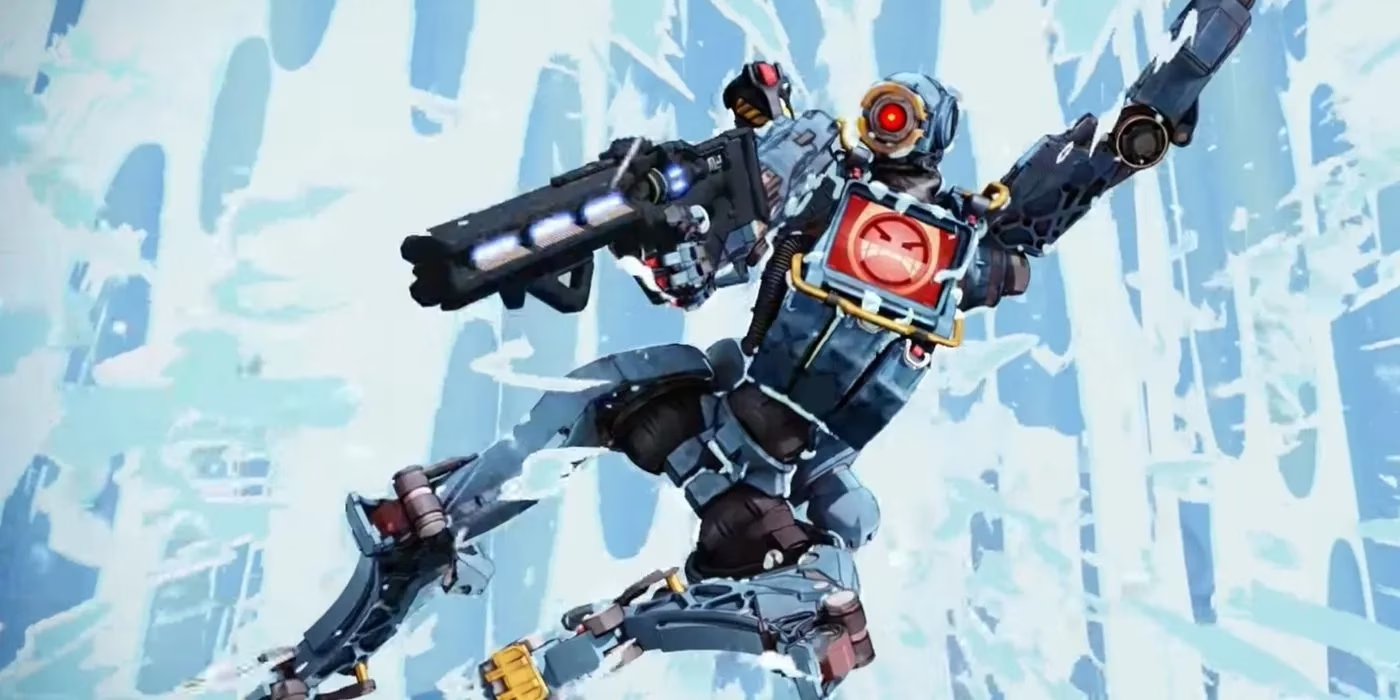
The most infamous grapple discovery centered on an almost endless pull. The concept sounded straightforward: Pathfinder had to connect his grapple to an enemy, then twist about 45 degrees to the right or left while pulling back against the normal movement. If the player timed that resistance correctly, the hapless target could be dragged far longer than usual. Some claimed that with perfect execution the enemy could be pulled indefinitely, turning a single duel into a nightmare of lost positioning.
Of course, the trick was far harder than it looked. Enemies were not training dummies. They strafed, returned fire, activated escape abilities and called for backup. Any wish to perfect the infinite grapple usually led players to the Firing Range, where the controlled environment allowed them to test the angle, the timing and the subtle directional tug without a full squad collapsing on them. Even there, the timing required was punishing. One mistimed pull would snap the grapple back to its normal duration, and the window for holding the target felt razor-thin.
Beyond the open-field infinite pull, another exploit surfaced when Pathfinder grappled an enemy standing behind a wall. If the hook connected, the victim could be yanked into the wall itself. Because collisions with surfaces triggered a slow climbing animation, the enemy became an easy target. A pinned, climbing opponent could not shoot back effectively, giving Pathfinder and his squad a brief but brutal opening to land headshots or push for the elimination.
Pathfinder’s grapple also worked on downed enemies, and that added an extra layer of cruelty. A knocked opponent hiding behind cover could be pulled into the open, forcing their teammates to decide whether to abandon the safe position or risk a rescue. Skilled Pathfinder players used this baiting strategy to isolate squads, pulling one member away and punishing any rescue attempt. Was it sportsmanlike? Maybe not. Was it effective? Absolutely.
🦾 Common Pathfinder Grapple Exploits and Effects
| Grapple Trick | What Happens | Battlefield Effect |
|---|---|---|
| 45-degree infinite pull | Enemy is dragged longer than intended | Destroys enemy positioning |
| Wall collision pull | Enemy triggers slow climb animation | Easy target for follow-up shots |
| Downed enemy pull | Knocked player is removed from cover | Forces risky rescue attempts |
| Super grapple mobility | Pathfinder launches across open space | Faster rotations and escapes |
These discoveries were not the first mobility oddities tied to Pathfinder. Players had already learned how to perform a super grapple, using the hook to launch the robot across huge distances with startling speed. Some extended the range and usefulness of his zipline ultimate, creating rotation paths that could catch an enemy team completely off guard. Pathfinder’s entire identity, after all, was built around movement. Every new exploit added another layer to the legend’s already high skill ceiling, rewarding players who devoted hours to mastering the physics of the hook.
Would Respawn Entertainment step in? Historically, the developer had not hesitated to nerf abilities or characters when they warped the competitive experience. But the infinite grapple and the wall pull existed in a strange gray area. Because they demanded such precise timing and were difficult to execute under real combat pressure, they did not feel as urgent as a damage bug or a map-breaking exploit. Still, players debated the issue constantly. Should a trick that requires near-frame-perfect execution be removed, or was it simply a reward for high-level mastery?
That question remained relevant as Apex Legends continued to evolve. Each new season brought legend balance changes, map updates and fresh meta shifts, and the community’s memory of old grapple tricks influenced how players approached Pathfinder. Some labbed the old techniques in private matches to see if they still worked. Others moved on to new legends and new movement tools. Yet the legend’s grappling hook retained its place as one of the most creative weapons in the game.
In the end, Pathfinder’s grapple exploits represented more than just overpowered tricks. They revealed how deep Apex Legends’ movement system could go when players refused to accept the intended limits. A cheerful robot with a grappling hook became a high-skill duelist, a repositioning master and a psychological threat all at once. Whether or not the old infinite pull still functions in 2026, the legend’s legacy as a movement pioneer is secure. And for anyone facing a Pathfinder who suddenly twists mid-grapple, the lesson remains simple: do not stand still.
Leave a Comment
Comments