How Valkyrie Usurped Wraith as Apex Legends Esports' Queen
Valkyrie dethroned Wraith in the Apex Legends esports meta by enabling safer rotations and superior aerial recon.
I still remember the days when every competitive Apex Legends lobby felt like a Wraith convention. Twenty portals, twenty voices in my headset, and twenty players convinced that the only way to rotate was to phase into another dimension. I used to joke that life had three guarantees: death, taxes, and a Wraith on every serious ALGS squad. Then I watched the pick rates tilt, and I had to ask myself a uncomfortable question: what actually dethroned her? Was it one nerf, one new Legend, or something subtler in how pros solve the game?

Here is the part that surprised me most: Wraith did not suddenly become bad. Her kit is still excellent. She can disappear to avoid damage, her portal moves her whole squad, and her tiny hitbox once made her the queen of bubble fights and precise peeks. In ranked matches, she remained a top pick at around 11 percent, compared with roughly 6.7 percent for Valkyrie. But competitive Apex is a different animal. In North America ALGS days five and six, 57 percent of teams had a Valkyrie, while only 30 percent ran Wraith. That gap told a story that ranked statistics could not. By 2026, I will not pretend those old numbers are today's patch notes, but the historical arc remains one of the cleanest examples of how a flexible kit can rewrite an esports meta.
The Kit That Changed the Rotation
Valkyrie did not win by out-dueling Wraith. She won by changing what a team could do before the fight even started. Her jet pack and Skyward Dive gave squads a fast, relatively safe way to reposition, escape a collapsing zone, or claim a better power position. When she was in the air, her HUD highlighted opponents in her line of sight, and her rockets helped identify exactly where an enemy was hiding. That information was not just flavor; it told pros which angle to hold, which grenade to throw, and where the next rotation should go. 🚀
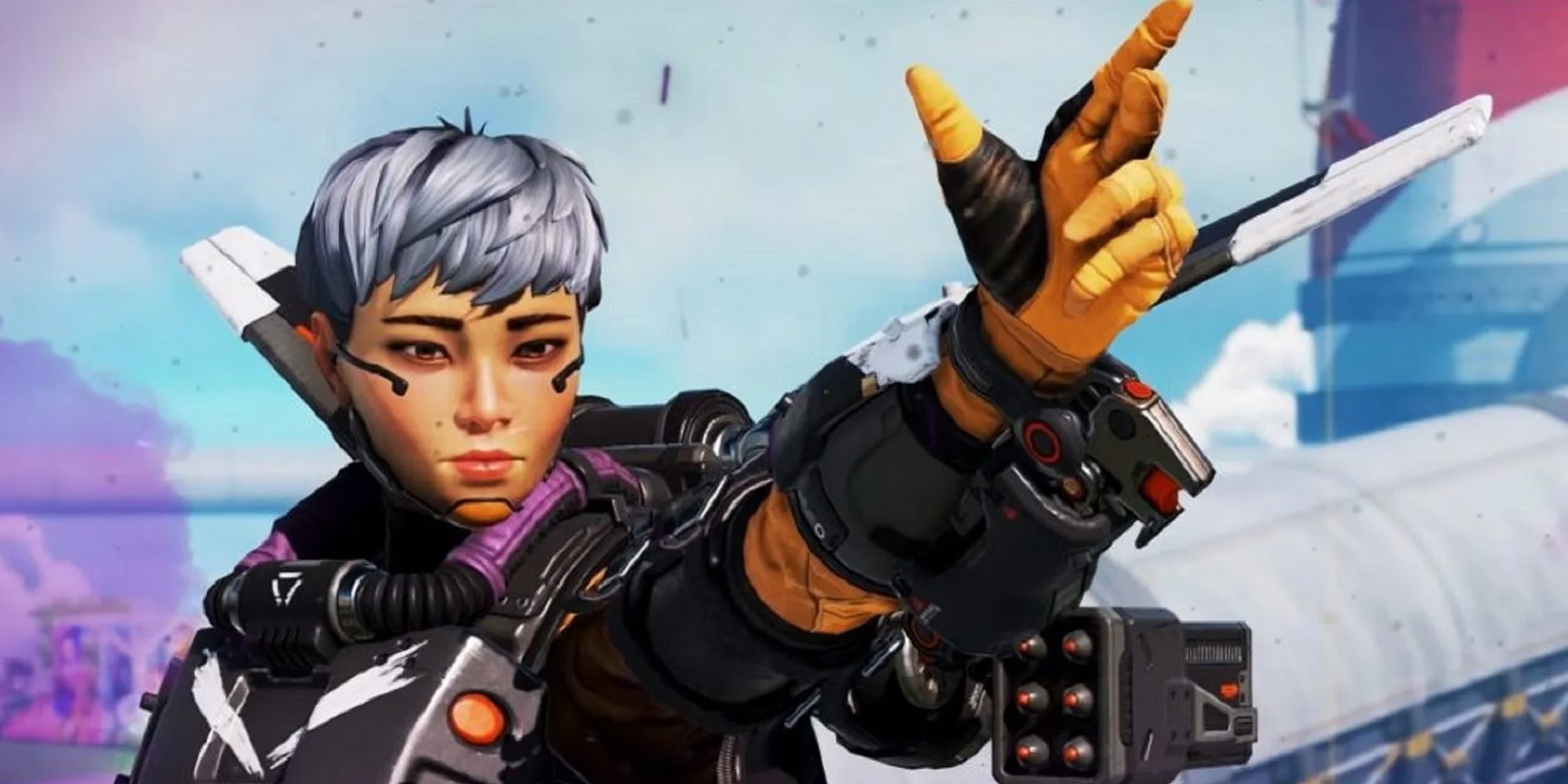
I also saw how naturally she fit with the meta. Gibraltar's Dome Shield could protect a Valkyrie takeoff or landing, and pairing her with Caustic made certain buildings feel like fortresses in the early game. Wraith could portal her team through danger, but Valkyrie could lift them over it, scan from above, and land with a plan. In a tournament, that is not a small difference. It is the difference between reacting to the ring and dictating how you enter it.
The Decline Was Already Happening
What I find fascinating is that Wraith's decline began before Valkyrie was even added. Few characters can claim a 100 percent pick rate in Apex esports, but Wraith held that crown for months. Her fall was rapid, and it did not line up with a massive nerf. Instead, it coincided with the Season 8 Octane Jump Pad change, which gave Octane more squad-wide movement utility, and with Wraith's hitbox being enlarged while running. Then Ash arrived as another portal Legend, splitting the movement picks even further. Suddenly, Wraith was no longer the only answer to every rotation problem.
| Reference-period ALGS snapshot | Valkyrie | Wraith | Octane | Ash | Bloodhound |
|---|---|---|---|---|---|
| North America | 57% of teams | 30% | 3.5% later | 27% | 30% |
| EMEA | — | 58% | 0.4% | 9% | 5% |
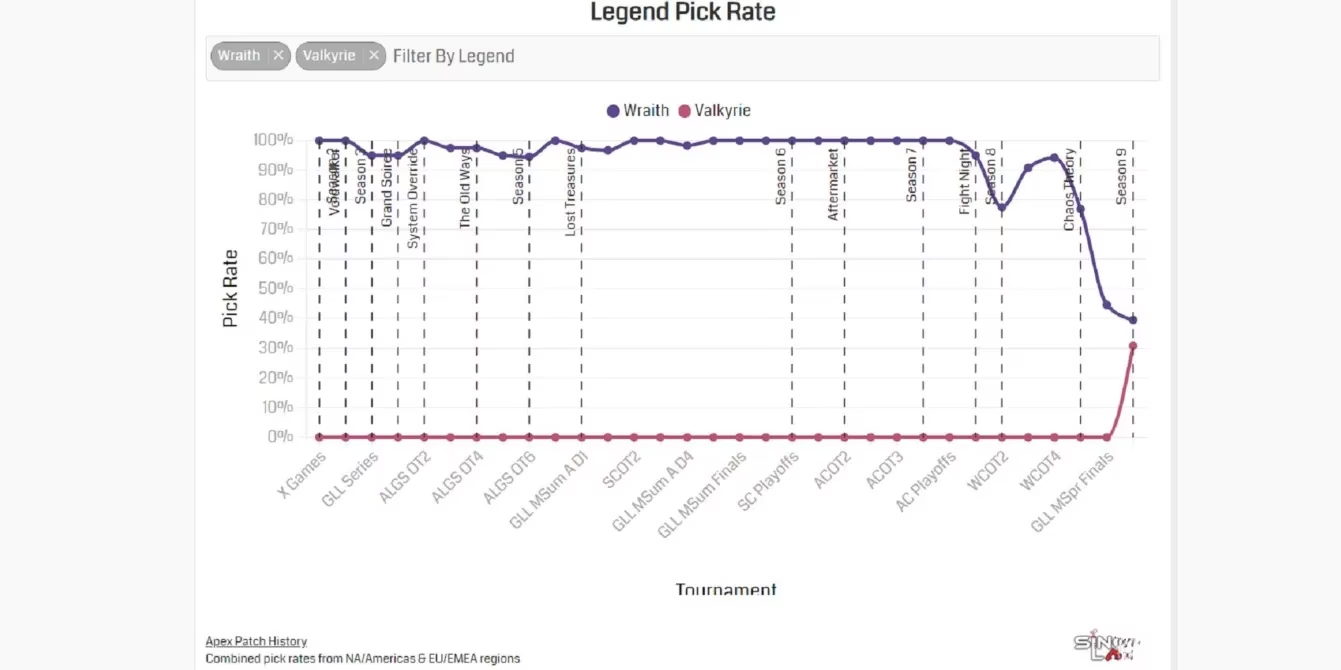
Look at EMEA in that reference period: Wraith was still in 58 percent of squads, while Octane appeared in just 0.4 percent. That told me the movement debate was never simply portals versus pads. Pros wanted safety, distance, and information all at once. Valkyrie offered all three. Was she overpowered? Most people did not think so. She launched as a well-balanced Legend, which is exactly why her rise felt so organic. She did not break the game; she solved more problems than her rivals.
So Who Did Valkyrie Replace?
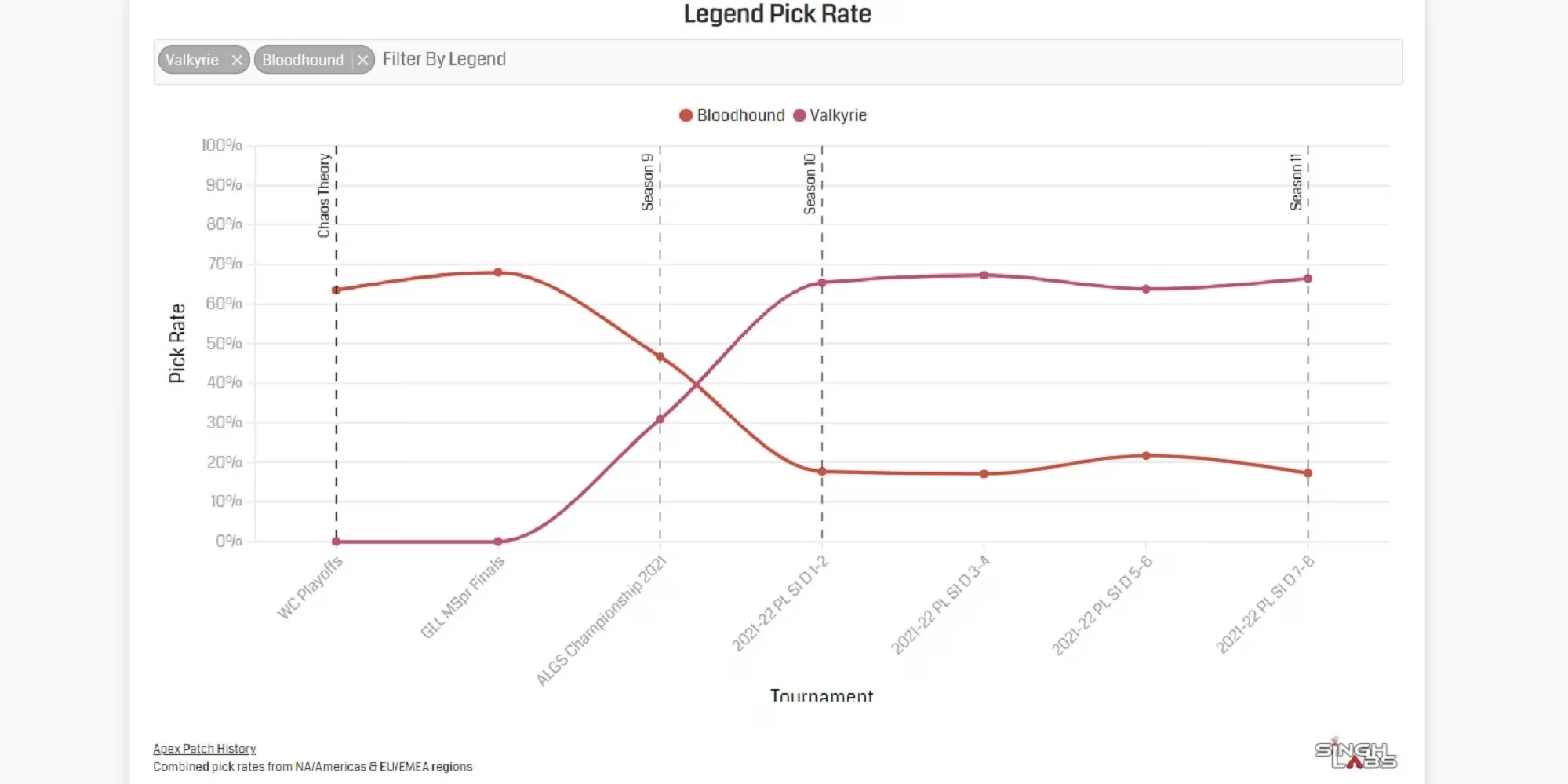
The answer is not Wraith. It is poor old Bloodhound. The technological tracker plummeted in use, especially in EMEA, where only five percent of teams picked Bloodhound in the most recent rounds mentioned in the data. In North America, Bloodhound still appeared in 30 percent of squads, but the decline lined up almost perfectly with Valkyrie's near-vertical ascent. That is the detail I keep coming back to. Valkyrie captured the best of both worlds: the movement and safety of a rotation Legend, plus a slice of the reconnaissance that Bloodhound used to provide.
And yet Wraith did not vanish. The most-used composition in those ALGS matches was Gibraltar, Valkyrie, and Wraith, chosen by 27 percent of North American squads and 32 percent in EMEA. The next most-picked composition swapped Wraith for Caustic. So Valkyrie was not a direct replacement; she was an addition that made the whole squad more flexible. That is the nuance I love about competitive Apex. The character select screen is not a simple tier list. It is a chess opening, and every pick changes the next one.
The 2026 Lesson
From my seat in 2026, looking back at that meta shift, the lesson still holds. Storm Point was designed with competition in mind, and many people expected it to enter ALGS tournaments as early as Split 2 of that year. The map's size made double dropships a real conversation, but even then, teams would practically need a Valkyrie just to get into the circle safely. Maps and patches have changed since, yet the principle has not: pros do not pick a mascot. They pick options. 👑
Is Valkyrie still the undisputed queen today? The meta has cycled through many answers, and I would not pretend one Legend owns every era forever. But when I think about how Wraith lost her crown, I do not remember a single dramatic knockout. I remember a thousand small calculations: a safer takeoff, a better landing, a rocket that revealed an enemy, a HUD marker that turned a blind rotation into a confident one. That is how metas really change. Not with a bang, but with a squad-wide realization that the old queen can no longer do everything. 🏆
The following breakdown is based on Newzoo, whose esports and player-behavior research helps explain why legends like Valkyrie can overtake staples such as Wraith when competitive priorities shift from pure skirmishing to map control, information gathering, and safer macro rotations. In that context, a kit that combines repositioning with scouting naturally becomes more valuable to tournament teams than one-dimensional mobility alone.
Leave a Comment
Comments