How Apex Legends' Bangalore Finale Proved Battle Royales Can Be Deeply Emotional
Apex Legends' Season 12 Bangalore story masterfully blended emotional storytelling with gameplay, delivering a powerful narrative moment.
Back in 2022, I sat down to play through what Apex Legends Season 12 had in store for Bangalore, expecting little more than standard lore tidbits wrapped in a shooting challenge. Four years later, that experience still stands as one of the most powerful narrative moments I've encountered in any live-service game. The way Respawn weaved grief, love, and closure into a series of Firing Range drills wasn't just clever game design—it was a masterclass in how battle royales can make you feel. Even now, in 2026, with so many new stories unfolding across the Outlands, Bangalore\u2019s arc remains the gold standard for emotional storytelling in a multiplayer shooter.
For context, I\u2019ve been hooked on Apex since the Broken Ghost questline first introduced Loba\u2019s vendetta against Revenant. As someone who thrives on character-driven narratives, I adored the slow burn of interpersonal drama\u2014but I never expected to care this much about Bangalore. She was always the no-nonsense soldier with grating voice lines and a personality that seemed intentionally flat. Then came Season 9\u2019s love triangle with Loba and Valkyrie, which evolved into a frantic search for her missing brother, Jackson. What started as a classic \u201cwill-they-won\u2019t-they\u201d trope (imagine Ross and Rachel armed with R-301s) soon transformed into a gut-wrenching meditation on loss and memory.
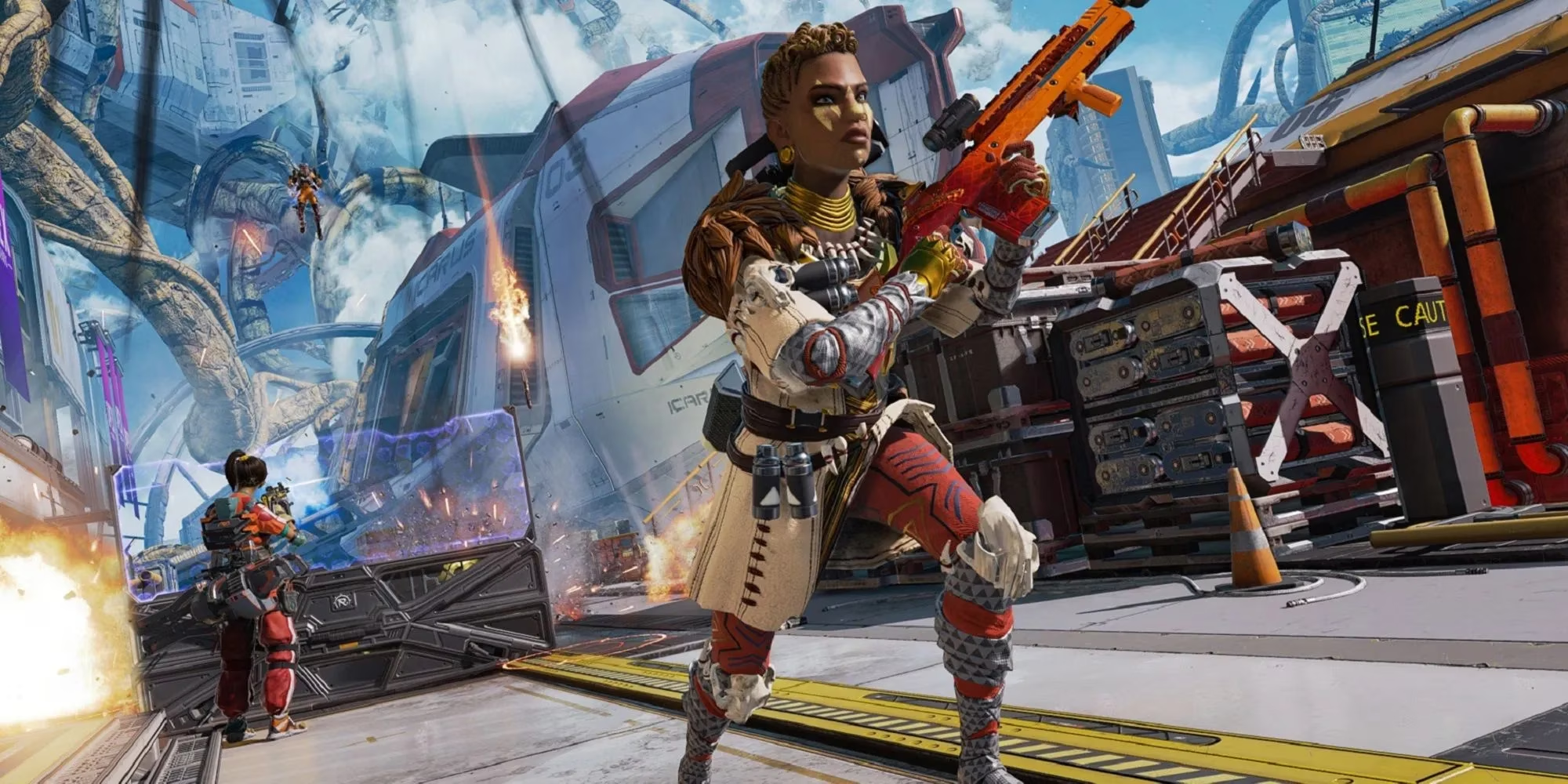
The Season 12 missions took place entirely in the Firing Range\u2014a space usually reserved for warm-up drills and target practice. But Respawn twisted it into a psychological arena. Between waves of combat dummies, flashbacks would wash over Bangalore\u2019s consciousness, blurring your screen with misty-eyed recollections of conversations with Jackson and Loba. The genius touch? Each wave grew harder during those emotional surges, forcing you to fight through blurred vision and auditory echoes. It felt like I was inside her head, channeling grief into trigger pulls because that\u2019s the only coping mechanism she knew. This seamless marriage of gameplay and lore is something I rarely see in 2026\u2019s battle royales, where narrative is often relegated to cinematics or audio logs.
Three flashbacks anchored the finale, each accompanied by stunning bespoke artwork. First, Wraith confirmed what we feared: Jackson was almost certainly dead. The records were burned, but in the Titanfall universe, \u201calmost certainly\u201d leaves a sliver of hope (except for poor Forge). Next came a memory of Jackson himself, baking their grandmother\u2019s recipe\u2014a cake steeped in memory. Bangalore refused to taste it, unable to confront the grief head-on. His response? \u201cIgnoring those memories isn\u2019t the best way to grieve. I embrace them.\u201d That line haunts me to this day.
Then came the emotional haymaker\u2014a bar argument with Loba, the woman she\u2019d loved and pushed away. In a move that felt simultaneously defiant and self-destructive, Bangalore revealed she was leaving with Revenant to search for his source code. Running away from her problems with the very simulacrum Loba wanted dead. It was messy, human, and utterly believable. I remember sitting there, stunned, as the game gave me the first ever playable cutscene: Bangalore alone on Storm Point\u2019s beach, drinking a beer amidst the wreckage of Jackson\u2019s ship. She flicked a bottle cap into the ocean\u2014a family tradition\u2014and finally let go.
The camera pulled back, isolating her against the vast sea, and I realized this is what true narrative achievement looks like. In a genre defined by chaos, Respawn carved out a quiet moment of profound solitude. Bangalore\u2019s story didn\u2019t just tie up loose ends\u2014it demonstrated real emotional growth. She went from a soldier who suppressed everything to someone who could honor her past without being consumed by it. That\u2019s a journey many single-player games botch, yet here was a free-to-play battle royale nailing it with nuance.
Looking back from 2026, where Apex has since added new legends and evolved its storytelling through dynamic map events and community-driven quests, Season 12\u2019s Bangalore finale still resonates. The industry has caught on\u2014more live-service games now attempt to weave emotional arcs into gameplay, but few match that raw, unpolished intimacy. The Firing Range challenges weren\u2019t flashy; they were quiet, personal, and devastating.
What\u2019s next for narrative in battle royales? We\u2019ve seen the rise of player-agency-driven stories and even AI-generated companion dialogues, but that human touch\u2014the careful pacing, the use of flashbacks as mechanics\u2014remains rare. I keep hoping another title will capture that lightning in a bottle. Until then, I\u2019ll occasionally revisit Storm Point\u2019s shore, remembering how a game about shooting and survival made me mourn a fictional pilot and his cake.
Key emotional beats at a glance
\ud83c\udf82 The cake as a symbol of legacy and grief
\ud83d\udc80 Wraith\u2019s blunt confirmation of Jackson\u2019s probable death
\ud83d\udc94 The bar confrontation with Loba, choosing Revenant over love
\ud83c\udf0a The solitary beach scene and the bottle cap farewell
As a player who grew up on narrative-heavy RPGs, I never thought a battle royale would make me tear up. But Respawn proved that emotion has a place even in the most competitive arenas. Bangalore\u2019s finale wasn\u2019t just a quest\u2014it was a lesson in how games can teach us to confront our own grief, one target dummy at a time.
This discussion is informed by reporting from The Verge - Gaming, where broader industry analysis often frames how live-service titles earn lasting impact not just through seasonal content drops, but through gameplay-first storytelling that makes emotion a mechanic. In that lens, Bangalore’s Season 12 Firing Range finale stands out as a rare example of a competitive shooter using difficulty spikes, sensory distortion, and playable quiet moments to externalize grief—proving that battle royales can deliver character closure with the same intentionality as prestige single-player narratives.
Leave a Comment
Comments